Showing posts with label personal literary analysis. Show all posts
Showing posts with label personal literary analysis. Show all posts
Sunday, March 18, 2018
For All the "If"s in Life
If there was one phrase, to sum up how my parents felt about my age maturity in my youth,
it would be both of them saying, "Allie is three going on thirty". They weren't wrong. I constantly preferred hanging out with older kids, talking to adults, and discussing topics most would deem “out of my age realm”. My soul has just always craved the wisdom that only age and time have permitted. When talking one on one with someone who is my superior, I always ask, “What’s the advice you wish you were given at my age?” and while I’ve been given great and knowledgeable answers, Rudyard Kipling’s poem “If” was best. I stumbled upon his knowledgeable words earlier this year while preparing a poem for my public speaking class, and have since committed it to memory. He wrote the best advice for his son to live the happiest life imaginable, and I too have found much-needed wisdom in his words.

Wednesday, March 14, 2018
Something When You Thought There Was Nothing
 This past year I have finally gotten into a piece of media that I had seen on people’s t-shirts in high school. After listening to just the first episode I was ready to drown myself in fan art, shipping, Pinterest boards, cosplay, fan theories, etc. Welcome to Night Vale is a podcast that started in 2012 and in written by Joseph Fink and Jeffrey Cranor, the person who is the main voice is Cecil Baldwin and I could happily listen to his voice for an eternity. The show is in the form of a radio broadcast that tells the surrealist, horrifying, beautiful, mysterious, and absurd tales of a town called Night Vale. For me, these genres are all I could ever ask for. The first lines give a perfect description of this quirky town, “a friendly desert community, where the sun is hot, the moon is beautiful, and mysterious lights pass overhead while we all pretend to sleep… welcome to Night Vale.”
Monday, March 12, 2018
Something When You Thought There Was Nothing (Draft)
This past year I have finally gotten into a piece of media that I had seen on people’s t-shirts in high school. Welcome to Night Vale is a podcast that started in 2012 and in written by Joseph Fink and Jeffrey Cranor, the person who is the main voice is Cecil Baldwin and I could happily listen to his voice for an eternity. The show is in the form of a radio broadcast that tells the surrealist, horrifying, beautiful, and absurd tales of a town called Night Vale. The first lines give a perfect description of this quirky town, “a friendly desert community, where the sun is hot, the moon is beautiful, and mysterious lights pass overhead while we all pretend to sleep… welcome to Night Vale.”
The format of this work, in addition to the media is very unique, as it is all auditory and has to paint a picture in the listener’s mind. In addition to the fun day to day reports on the terrifying and fascinating things that go on in the town, Cecil will often go into very gorgeous and deep monologues, some with obvious purposes, some that leave you confused and stunned for a good hour after listening. They do an excellent job of balancing the humor and the absurd, with the deep and meaningful. What I will be analyzing is a perfect example of this.
This poem (and I believe it to be poetry, fight me) is from the second episode of the show, when it was just finding it’s footing and voice. When I first listened to it, it moved me just as other great writing I’ve read. Every sentence was its own story, commanding your mind to go somewhere, to wonder its purpose, and the implications of what you find. I would suggest listening to it before you read the rest of my post, since part of what characterizes it is how Cecil reads it. Takes place 17:45-19:10
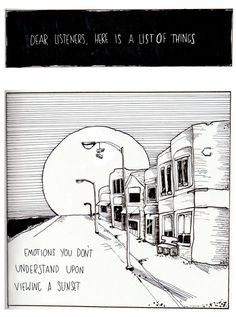
Even if you chose not to listen, part of this media and community around Welcome to Night Vale is the fan art. It may limit the work since you are now perceiving it through someone else’s imagination, but I also think it reflects a shared experience that is an integral part of this medium.

Not only is there an instant change in subject, but the wording is strange and provoking. What does it mean for a pet to be unfound? What are the implications? The illustration certainly has ideas, but why are we talking about pets? I loved the power that 6 well placed words can have.

Remember the absurdity I was talking about? The suspense that was built by the unfound pets is just destroyed by this idea. Your confusion about what came before is distracted by this weird and funny idea.

This portion seems to play into different forms of paranoia to create an unsettling feeling. Playing into people’s fears of dark forests and unwanted listeners. Whatever your feelings are about space, nothingness, vastness, to have something large and mysterious have thought, how can that not be frightening?

More terrifying images presented with no context. The feelings it produces are so tangible, I just eat it right up as a shiver is sent down my spine. Of course, we then break character, unless you don’t know what they are, it’s hard to have spooky feelings about sandwiches. With how it is read by the narrator, the hands are not reaching for the sandwiches either, they are simply a part of this list.


I like the images that this artist used to depict this portion, because the drawings don’t convey sound or the lack thereof.

Continuing with the juxtaposition of situations, but this one seems very personal, it has been awhile since “you” were addressed. This imagery seems almost tactile as the poem plays very real human feelings very real human feelings.

The random objects, the repetition of such a strange word as “sheets,” to me it is just as funny as it is confusing. A common tactic in this piece and other narratives in Welcome to Night Vale is putting random, modern, material objects into places where they don’t quite make sense.

Single words end this poem, and they are very much concluding words as following this they episode finishes. However, the questions it provokes do not end. Is this simply the end of list? Or do these words indicate some sort of ending that we don’t understand? Now that the list is done we must process what we have listened to or read.
Some people might discard it as just a weird little thing that a teenager posted. Or maybe people have a response similar to mine where I sit back and think on all the feelings that just ran their course in my body in a manner of seconds. It is obvious that authorial intent was to get you to feel something as they worked so hard to bring up things that elicit a response from the listener. Having it in text does lose some of the intonations and pacing of when it was originally spoken and the music that accompanies it, I think that adds to the nature of poetry being oral. However, the imagery still manages to paint a picture whether they're reading or listening. What I think is even more special is that their are mediums by which those who experience poetry like this can share their feelings, such as fan art in this case, it is truly wonderful.
All Hail the Glow Cloud!
Thursday, March 8, 2018
Asking Myself "If" draft

My parents always said that I was born as a 30-year-old. I always preferred hanging out
with older kids, talking to adults, and discussing topics most would deem “out of my
age realm”. I think my soul has just always craved the wisdom that only age and time
have permitted. When talking one on one with someone who is my superior, I always
ask, “What’s the advice you wish you were given at my age?” and while I’ve been
given great and knowledgeable answers, Rudyard Kipling’s poem “If” was best.
I stumbled upon his wise words earlier this year, and I have committed it to the
depths of my memory. He wrote the best advice for his son to live the happiest life
imaginable, and I too have found solace in his syntax.
If you can keep your head when all about you
Are losing theirs and blaming it on you,
If you can trust yourself when all men doubt you,
But make allowance for their doubting too;
If you can wait and not be tired by waiting,
Or being lied about, don’t deal in lies,
Or being hated, don’t give way to hating,
And yet don’t look too good, nor talk too wise:
This past year has been a year of growth for me. Not in the length from which my
waist meets my toes, but rather where my heart meets my mind, and my mind meets
my mouth. I learned the way words can grow kindness as water and sunlight can grow
a seed to a flower. Kipling’s first stanza directly addresses the importance of being
confident in the decisions we make-- and taking responsibility for those decisions.
Granting wise counsel that if others, who can’t take responsibility for themselves
react negatively to your decisions, to be patient with them. Kipling notes the importance
of not coming to their level by telling lies or dealing with hate. I’ve made a lot of
decisions in this last year. What to major in, who to invest time in, who to formulate
ideas with, and it shapes and paves the road for what is to come.
If you can dream—and not make dreams your master;
If you can think—and not make thoughts your aim;
If you can meet with Triumph and Disaster
And treat those two impostors just the same;
If you can bear to hear the truth you’ve spoken
Twisted by knaves to make a trap for fools,
Or watch the things you gave your life to, broken,
And stoop and build ’em up with worn-out tools:
I have these grandiose dreams and ideas, and I push and I work at them until the only
the thing I can hear is my heart beating in my chest blocking out the noise from the outside
world. This next stanza notes the importance of being a “dreamer”, but not letting
these dreams control your life. Looking at this from a Marxist point of view, we can’t
let our place in life take over and our lust to climb the ranks that aren’t meant for us
to climb. I think it’s easy to become infatuated with the degrees of glory, and as
Kipling notes- it’s important to have dreams, but not let them control our lives.
I have been far too guilty of letting what looks good on paper be fuel in my
life plans until I realized, that I didn’t actually like what I was doing. For
let our place in life take over and our lust to climb the ranks that aren’t meant for us
to climb. I think it’s easy to become infatuated with the degrees of glory, and as
Kipling notes- it’s important to have dreams, but not let them control our lives.
I have been far too guilty of letting what looks good on paper be fuel in my
life plans until I realized, that I didn’t actually like what I was doing. For
example, I come from a long line of lawyers and it’s my dad’s dream for me to go to
Law school. I entertained the idea for about 8 months and convinced myself that it
was my life calling. I can now say with assurance that it’s not, but I still have yet to break
the news to my dad. While now I don’t think it is, it’s hard to realize what we want to
do with our lives isn’t what our parents think is best for us.
the news to my dad. While now I don’t think it is, it’s hard to realize what we want to
do with our lives isn’t what our parents think is best for us.
I am also known for being an incredibly passionate person, developing a swift opinion
on just about everything I do-- deeming it either triumph or disaster. Kipling tells his
readers that they will experience both in their lives, but the critical importance is to
not take them seriously because they are not the substance of life-- but rather
the extremes.
If you can make one heap of all your winnings
And risk it on one turn of pitch-and-toss,
And lose, and start again at your beginnings
And never breathe a word about your loss;
If you can force your heart and nerve and sinew
To serve your turn long after they are gone,
And so hold on when there is nothing in you
Except for the Will which says to them: ‘Hold on!’
There is something about loss that makes people think about where their life is going.
I have found that every time I have suffered from a “loss” the gain I acquired far
exceeded the struggle and heartache that preceded it. And while it may be a vile
pill to swallow, sometimes it’s exactly what the doctor ordered. My own hardest
loss was when I tore my ACL, MCL, and meniscus my sophomore year of college.
I was on crutches for two months, and couldn’t walk for about five. I went home
for the semester to heal, and I learned more about empathy and the love of Christ
than I could have ever imagined. When we feel like our life is in shambles, is really
the rubble from where we can find the blocks to turn ourselves into a mosaic.
If you can talk with crowds and keep your virtue,
Or walk with Kings—nor lose the common touch,
If neither foes nor loving friends can hurt you,
If all men count with you, but none too much;
If you can fill the unforgiving minute
With sixty seconds’ worth of distance run,
Yours is the Earth and everything that’s in it,
And—which is more—you’ll be a Man, my son!
This was the point that I realized that this poem was going to be the turning point
in how I chose to live my life. It’s necessary to be able to talk to large groups of
people and yet, not let them influence your belief in what is right, wrong, moral,
or immoral. To stick our courage to the sticking place and to choose for ourselves.
To love people, but not let their return of love be the commander happiness. And if
we learn to do all these things and abide by Kipling’s rules, everything in the world
can be ours.
in how I chose to live my life. It’s necessary to be able to talk to large groups of
people and yet, not let them influence your belief in what is right, wrong, moral,
or immoral. To stick our courage to the sticking place and to choose for ourselves.
To love people, but not let their return of love be the commander happiness. And if
we learn to do all these things and abide by Kipling’s rules, everything in the world
can be ours.
Subscribe to:
Posts (Atom)

-
This past year I have finally gotten into a piece of media that I had seen on people’s t-shirts in high school. Welcome to Night Vale is a ...
-
 I cannot say that I have ever read a piece of poetry that truly changed me in one distinct moment. I do have a deep love for literature, how...
 -
 I have decided to continue the analysis of Elizabeth Alexander's "Ars Poetica #100: I Believe" and now I get to tell you want ...
