I learned a lot through this blog, putting myself out there and writing in an informal way again, helped me to gain confidence in myself and my writing. I had already had a lot of experience with looking at text and drawing out devices and techniques. I've done a lot with talking about their affect, but actually getting into particular critical approaches was the next step for me. Not only looking at literature in those different ways, but on this blog I have been able to see how different people perceive works of literature. Ideas and angles I would have never been inclined to think of were eye-opening to me and helped me recognize my own biases and preferences. Just as I am able to recognize the biases and limitations of different approaches, I can see them in myself and others. This seems to be not just a literature skill but a life skill as well.
I think one of the most important lessons I learned here was that analyzing literature in thoughtful and valid ways isn't confined to formal analysis. I can express similar ideas in a blog post as I do in a formal paper, and have just as much fun and passion with both. When we analyzed a piece of poetry, my first thought was to do something normal, like a Yeats poem. Not that his poetry isn't brilliant, but I realized I didn't need to be confined to what is generally considered "poetry." I found that scripture can be considered literature, and I've been trying to find new ways of studying the scriptures, and looking at them through the lens of literary analysis may provide new insights. At the very least it would be an interesting activity. This has also made me more invigorated to read on my own time again. Life is crazy and busy, but I've realized how important it is for me to read, think, and share ideas that I have discovered. This is the only class where I haven't dreaded group work, maybe it's the people, but my love of discussion and analysis has been able to shine. This has been a good time, thank you all<3
Showing posts with label posted by Mya S. Show all posts
Showing posts with label posted by Mya S. Show all posts
Tuesday, April 17, 2018

Tuesday, April 3, 2018
Show and Tell feat.Terrible Doodles!
I have decided to continue the analysis of Elizabeth Alexander's "Ars Poetica #100: I Believe" and now I get to tell you want I want to talk about specifically.
My working thesis is: Despite the perception that Elizabeth Alexander's poem is rambling and almost ranting, she actually is able to argue her point that poetry is important in an assertive and clever way by using structure, imagery, and metaphor.


My working thesis is: Despite the perception that Elizabeth Alexander's poem is rambling and almost ranting, she actually is able to argue her point that poetry is important in an assertive and clever way by using structure, imagery, and metaphor.

- Starting off with the acknowledgement of authorial intent and the fact that this poem is of the genre that are poems about poetry (this explanation may or may not stay in the intro). She is addressing her audience that appears to be her students as she is explaining what she would tell them about poetry, she is trying to be persuasive and that is seen in the emphasis in certain areas of the poem. The pacing is quick with the couplets and is meant to keep attention, but important points are emphasized rather than skimmed or rambled through.

- Tension is built in the poem along with the pace and this is why this poem may be seen as rant, but Alexander acknowledges the tension building showing self-awareness that strengthens her control in the poem. As she is using poetic devices she slowly escalates showing even more control and balances her passion with her argument.

- Lastly she supports her argument through the use of imagery and metaphors as a way of introducing ideas into the reader/listener's mind. The images work to potentially inspire or enlighten and work as Alexander's evidence. Like a teacher engaging her students she tries to make this lessen applicable them so that they care and she ends in a classic teacher-like way, with a question.
Friday, March 23, 2018
Meta Poetica Part II

Writing out and annotating a poem is an excellent way to really pull apart and understand a poem. From this we can really start to form different kinds of claims to talk about the poem:
Policy Claim: Elizabeth Alexander's poem should be read out loud because of how it is paced, the tone, and tension she builds.
Definition Claim: This poem is about the poet's belief that poetry is inspired by happenstance occurrences in human lives, she expresses this through metaphor and questions.
Comparison Claim: Elizabeth Alexander's poem claims that poetry is like the small details and inspirations in a humans life through this poem with metaphors and an assertive tone.
Evaluation Claim: "Ars Poetica: #100: I believe" is best understood as a plea to young people to take poetry seriously and as a way to connect to others by using understandable metaphors and a passionate tone.
Causal Claim: Elizabeth Alexander causes the the reader to reflect on their relationship with poetry, and by extension how it connects them to the world around them by using personal metaphors and asking questions to instigate personal reflection.
Monday, March 19, 2018
Meta Poetica
8 steps to responding to your poem (especially if it's a poem about poetry):
1) Reading the poem out loud is a good way to start, go ahead!
Ars Poetica #100: I Believe
by, Elizabeth Alexander

Poetry, I tell my students,
is idiosyncratic. Poetry
is where we are ourselves
(though Sterling Brown said
“Every ‘I’ is a dramatic ‘I’”),
digging in the clam flats
for the shell that snaps,
emptying the proverbial pocketbook.
Poetry is what you find
in the dirt in the corner,
overhear on the bus, God
in the details, the only way
to get from here to there.
Poetry (and now my voice is rising)
is not all love, love, love,
and I’m sorry the dog died.
Poetry (here I hear myself loudest)
is the human voice,
and are we not of interest to each other?
1) Reading the poem out loud is a good way to start, go ahead!
Ars Poetica #100: I Believe
by, Elizabeth Alexander

Poetry, I tell my students,
is idiosyncratic. Poetry
is where we are ourselves
(though Sterling Brown said
“Every ‘I’ is a dramatic ‘I’”),
digging in the clam flats
for the shell that snaps,
emptying the proverbial pocketbook.
Poetry is what you find
in the dirt in the corner,
overhear on the bus, God
in the details, the only way
to get from here to there.
Poetry (and now my voice is rising)
is not all love, love, love,
and I’m sorry the dog died.
Poetry (here I hear myself loudest)
is the human voice,
and are we not of interest to each other?
Wednesday, March 14, 2018
Something When You Thought There Was Nothing
 This past year I have finally gotten into a piece of media that I had seen on people’s t-shirts in high school. After listening to just the first episode I was ready to drown myself in fan art, shipping, Pinterest boards, cosplay, fan theories, etc. Welcome to Night Vale is a podcast that started in 2012 and in written by Joseph Fink and Jeffrey Cranor, the person who is the main voice is Cecil Baldwin and I could happily listen to his voice for an eternity. The show is in the form of a radio broadcast that tells the surrealist, horrifying, beautiful, mysterious, and absurd tales of a town called Night Vale. For me, these genres are all I could ever ask for. The first lines give a perfect description of this quirky town, “a friendly desert community, where the sun is hot, the moon is beautiful, and mysterious lights pass overhead while we all pretend to sleep… welcome to Night Vale.”
Tuesday, March 13, 2018
Invasion of the Mind
All the different genres of poetry that I looked at, with the text was written, spoken, or both. They all showed me how alive poetry if, and how it has always been a source of expression. Whether it is a personal expression of feelings to share out loud with the world. Or in film talking about personal, but relate-able experiences with the time and culture. In the films where poetry was performed in clubs, not only was that an example of the performance nature of poetry that has continued, but mixing that with instrumentals gives it new life and vitality. With videos that put the text on the screen and/or mix it with images also give new ways to experience poetry which is really cool and caters to a changing, digitally oriented audience. This is also effective in the music adaptations, they give way to entertaining new ways of performance, and the chance for the artists to express the poetry in new ways. With new poetry (and some old) seeing it read aloud by their authors is also neat, although I've seen it be not as great for the poem, but it can also be very inspiring to hear the author's emotions or how they imagined it to be read. I admire all these different forms of presentation, and I love to see the passion and time that people put in to the performance and creation of this art.
Monday, March 12, 2018
Something When You Thought There Was Nothing (Draft)
This past year I have finally gotten into a piece of media that I had seen on people’s t-shirts in high school. Welcome to Night Vale is a podcast that started in 2012 and in written by Joseph Fink and Jeffrey Cranor, the person who is the main voice is Cecil Baldwin and I could happily listen to his voice for an eternity. The show is in the form of a radio broadcast that tells the surrealist, horrifying, beautiful, and absurd tales of a town called Night Vale. The first lines give a perfect description of this quirky town, “a friendly desert community, where the sun is hot, the moon is beautiful, and mysterious lights pass overhead while we all pretend to sleep… welcome to Night Vale.”
The format of this work, in addition to the media is very unique, as it is all auditory and has to paint a picture in the listener’s mind. In addition to the fun day to day reports on the terrifying and fascinating things that go on in the town, Cecil will often go into very gorgeous and deep monologues, some with obvious purposes, some that leave you confused and stunned for a good hour after listening. They do an excellent job of balancing the humor and the absurd, with the deep and meaningful. What I will be analyzing is a perfect example of this.
This poem (and I believe it to be poetry, fight me) is from the second episode of the show, when it was just finding it’s footing and voice. When I first listened to it, it moved me just as other great writing I’ve read. Every sentence was its own story, commanding your mind to go somewhere, to wonder its purpose, and the implications of what you find. I would suggest listening to it before you read the rest of my post, since part of what characterizes it is how Cecil reads it. Takes place 17:45-19:10
Even if you chose not to listen, part of this media and community around Welcome to Night Vale is the fan art. It may limit the work since you are now perceiving it through someone else’s imagination, but I also think it reflects a shared experience that is an integral part of this medium.
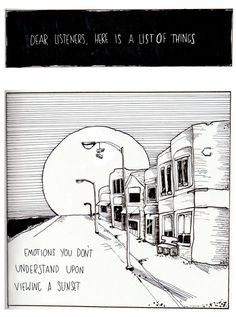

Not only is there an instant change in subject, but the wording is strange and provoking. What does it mean for a pet to be unfound? What are the implications? The illustration certainly has ideas, but why are we talking about pets? I loved the power that 6 well placed words can have.

Remember the absurdity I was talking about? The suspense that was built by the unfound pets is just destroyed by this idea. Your confusion about what came before is distracted by this weird and funny idea.

This portion seems to play into different forms of paranoia to create an unsettling feeling. Playing into people’s fears of dark forests and unwanted listeners. Whatever your feelings are about space, nothingness, vastness, to have something large and mysterious have thought, how can that not be frightening?

More terrifying images presented with no context. The feelings it produces are so tangible, I just eat it right up as a shiver is sent down my spine. Of course, we then break character, unless you don’t know what they are, it’s hard to have spooky feelings about sandwiches. With how it is read by the narrator, the hands are not reaching for the sandwiches either, they are simply a part of this list.


I like the images that this artist used to depict this portion, because the drawings don’t convey sound or the lack thereof.

Continuing with the juxtaposition of situations, but this one seems very personal, it has been awhile since “you” were addressed. This imagery seems almost tactile as the poem plays very real human feelings very real human feelings.

The random objects, the repetition of such a strange word as “sheets,” to me it is just as funny as it is confusing. A common tactic in this piece and other narratives in Welcome to Night Vale is putting random, modern, material objects into places where they don’t quite make sense.

Single words end this poem, and they are very much concluding words as following this they episode finishes. However, the questions it provokes do not end. Is this simply the end of list? Or do these words indicate some sort of ending that we don’t understand? Now that the list is done we must process what we have listened to or read.
Some people might discard it as just a weird little thing that a teenager posted. Or maybe people have a response similar to mine where I sit back and think on all the feelings that just ran their course in my body in a manner of seconds. It is obvious that authorial intent was to get you to feel something as they worked so hard to bring up things that elicit a response from the listener. Having it in text does lose some of the intonations and pacing of when it was originally spoken and the music that accompanies it, I think that adds to the nature of poetry being oral. However, the imagery still manages to paint a picture whether they're reading or listening. What I think is even more special is that their are mediums by which those who experience poetry like this can share their feelings, such as fan art in this case, it is truly wonderful.
All Hail the Glow Cloud!
Monday, March 5, 2018
Deaf Perception
The first technical thing I noticed about this short film was the set choices and movement. Having it start with the tutor on her bike in the English countryside seemed very open and as she rode her bike throughout the film it always seemed like we were moving towards something. At the start of the film we didn't know what we were moving towards and then as the journey continued we maintained our progress towards helping Libby get the education she needs.This made the time when the tutor was stopped by the phone call all the more significant because that stopped everything. Her on her bike, on dirt roads, with the open sky seem to represent an open minded and progressive view. That can also be seen when they are playing outside. While in places like the house, and the car can be seen as oppressive and tight. In the beginning the house is crowded and loud, with siblings and parents rushing everywhere, this tightness makes things seem claustrophobic. Libby is always sitting and seldom moves in the house, she prefers to watch TV than do anything else. However, when they leave the house she runs and plays, outside is a more carefree and accepting world.
The next thing that struck me was the acting and framing. Given the realistic fiction genre they made things very true to life and the actors were not particularly dramatized. The character who is speaking is usually at the center of the screen and they are usually having a back and forth conversation. Libby is often in the corner of the frame while other people are speaking, but when she starts to sign she also gets a turn in the middle of the shot. This may lend itself to the fact that with sign language you are required to maintain eye contact, not just for understanding, but as a courtesy to those you are signing to. So there is significance whenever someone makes eye contact with Libby because they are giving her respect. Another point of acting is that sign language is very expressive and because Libby starts out very passive, it is significant for her character when she smiles and has facial expressions, and that development is seen in the film.
The last thing I want to touch on is sound, since it is so significant when talking about deafness. This film is meant for hearing people to see so it makes sense that it does have music. In the moment where we get a view though Libby's eyes we get a sense of the silence that she experiences, as they put it in slow motion we see the expressions of each of the characters. Through this the audience is permitted to empathize with her, but also get a sense of her intelligence. She picks up things through facial expressions and lip-reading, but not everything and she is unable to engage in the conversation. The barrier of the lack of sound becomes a barrier in her relationship with others. The music is not highly emphasized in this film as much as the visuals and that is definitely intentional, they use the music, sound, or lack thereof to guide your emotions, but you're never going to take your eyes off the screen. On a personal note I have been studying ASL for a while now and film has become very important in Deaf culture, Deaf and hard of hearing people are often separated by distance, but media like this is a perfect way of sharing ideas.
The next thing that struck me was the acting and framing. Given the realistic fiction genre they made things very true to life and the actors were not particularly dramatized. The character who is speaking is usually at the center of the screen and they are usually having a back and forth conversation. Libby is often in the corner of the frame while other people are speaking, but when she starts to sign she also gets a turn in the middle of the shot. This may lend itself to the fact that with sign language you are required to maintain eye contact, not just for understanding, but as a courtesy to those you are signing to. So there is significance whenever someone makes eye contact with Libby because they are giving her respect. Another point of acting is that sign language is very expressive and because Libby starts out very passive, it is significant for her character when she smiles and has facial expressions, and that development is seen in the film.
The last thing I want to touch on is sound, since it is so significant when talking about deafness. This film is meant for hearing people to see so it makes sense that it does have music. In the moment where we get a view though Libby's eyes we get a sense of the silence that she experiences, as they put it in slow motion we see the expressions of each of the characters. Through this the audience is permitted to empathize with her, but also get a sense of her intelligence. She picks up things through facial expressions and lip-reading, but not everything and she is unable to engage in the conversation. The barrier of the lack of sound becomes a barrier in her relationship with others. The music is not highly emphasized in this film as much as the visuals and that is definitely intentional, they use the music, sound, or lack thereof to guide your emotions, but you're never going to take your eyes off the screen. On a personal note I have been studying ASL for a while now and film has become very important in Deaf culture, Deaf and hard of hearing people are often separated by distance, but media like this is a perfect way of sharing ideas.
Friday, March 2, 2018
Thank You to People Who Ask Questions
The first session of the English Symposium that I attended
was the Writing 150 Award Winners and going into to it I didn't know
what to expect. My reaction to the fact that it would simply be a reading of
people's essays did not deter me however, I drew the entire time to make sure I
kept my focus. It didn't really surprise me that most of them were personal
essays, I just didn't know that was an option to write on. I did enjoy the two
research papers that there were, particularly the one on 3-D printed firearms.
Maybe it was because it contrasted so much with the other essays, but it was
very interesting and well thought out.
The second session I attended was the My English+ Stories and it was incredibly interesting and diverse. I enjoyed the format of the presentations as they each had 20 slides, 15 seconds per slide, with a total of 5 minutes per slide. There were a few that covered their study abroad trips and although that did not rekindle my old desires to do that, I found it fun to hear their stories. One person in particular named Isaac mentioned Doctor Burton several times, I bet he is proud to have had an influence in this young man's life. There were a few entrepreneurs in the group which was fascinating and really cool to see what they have been able to accomplish. Overall it was cool to hear how important an English degree can be, and how passionate people are about it.
To give an explanation to my title, we had time at the end of each session for questions. Neither of the groups were very large and the threat of awkward silence was imminent. Thankfully a soul or two would ask questions, and the participants did their best (more or less) not to answer so awkwardly that anyone spontaneously exploded. For the English+ panel someone asked how to respond when you tell someone you're an English major and they ask if your teaching. There were a few good suggestions, some more sassy than others.
Friday, February 9, 2018
¡Bien Trabajo Romeo y Julieta!
Yes, I know, I verbally and quite bluntly expressed my dislike for Romeo and Juliet, but! I enjoy performances so I didn't go into it with a negative mindset. It was phenomenal, by the way before I get into the analysis. I spoke with one of the actors before the show began and he said that having read all of Shakespeare's works he felt similar to how I did in regards to the play but that he strongly loves this production, and I would have to agree.
One thing that surprised me going in was how small the cast was, there were only 8 actors, and they stayed on stage the entire time. They had very little props and they were all directed and moved by those on stage. This makes sense since this is meant to be performed at schools where the venue may not accommodate a lot of set material. With all of the actors never leaving the stage the use of positioning was very pinpoint. The center of the stage was where all of the real time action happened, and the right and left sides was "offstage" where actors with more than one role would change, where they had props, and instruments. Given that offstage was visible to the audience they used this to their advantage to set the tone, setting, and atmosphere. Those offstage would portray body language and facial expressions to express what was going on "onstage" and make sound effects and drum on the stools and floor. This intimacy and minimal set made the play not only more personal but alive, it wasn't a reflection of real life as much as it was a performance, a work of art. The actors did all their own work, moving the set, making the music, guiding the transitions. Given their small set and limited cast they addressed the audience and included us in the story.
I would like to speak briefly (because I only have so many words) on the decision to include the audience and why I think they chose to adapt it the way they did. This play was, in one word, 'entertaining' it is half comedy, half tragedy. This is because it has children as the intended audience, the Spanish adaptation, the clash of culture, the humor, the suspense. At the beginning the characters introduce themselves and their roles and relations to others in the play as though you were reading the character list at the beginning. A lot of kids seeing this won't know a lot about the story going in. This performance does an excellent job at knowing their audience.

One thing that surprised me going in was how small the cast was, there were only 8 actors, and they stayed on stage the entire time. They had very little props and they were all directed and moved by those on stage. This makes sense since this is meant to be performed at schools where the venue may not accommodate a lot of set material. With all of the actors never leaving the stage the use of positioning was very pinpoint. The center of the stage was where all of the real time action happened, and the right and left sides was "offstage" where actors with more than one role would change, where they had props, and instruments. Given that offstage was visible to the audience they used this to their advantage to set the tone, setting, and atmosphere. Those offstage would portray body language and facial expressions to express what was going on "onstage" and make sound effects and drum on the stools and floor. This intimacy and minimal set made the play not only more personal but alive, it wasn't a reflection of real life as much as it was a performance, a work of art. The actors did all their own work, moving the set, making the music, guiding the transitions. Given their small set and limited cast they addressed the audience and included us in the story.
I would like to speak briefly (because I only have so many words) on the decision to include the audience and why I think they chose to adapt it the way they did. This play was, in one word, 'entertaining' it is half comedy, half tragedy. This is because it has children as the intended audience, the Spanish adaptation, the clash of culture, the humor, the suspense. At the beginning the characters introduce themselves and their roles and relations to others in the play as though you were reading the character list at the beginning. A lot of kids seeing this won't know a lot about the story going in. This performance does an excellent job at knowing their audience.

Wednesday, January 31, 2018
These Paths Don't Converge
The first thing that stood out to me in the story Shiloh was the genre. I got a bit of a feel of what it was going to be from the author's bio, but as soon as read the first sentence I knew I was in for a realistic fiction, white, middle class story. Much like Raymond Carver's stories, I knew going in that the conflict would most likely be internal or with character relationships. Both of these exist in Shiloh and thus character is also a big part of the analysis as you get a sense of each of the characters and how their relationships work. Leroy's injury has rendered him unable to continue his job and you can see him losing his sense of purpose as he does crafts, drives around aimlessly, and tries to grasp an impossible dream of a log cabin for his wife. Whereas Norma Jean has been moving on without him, she has her own job that she is very passionate about, she is body building, and going to school. Not only has she replaced him as the "man of the house" but all this time while Leroy has been away at work she has been becoming more and more independent.
We can see through this characterization the internal conflict going on in these two, even though they are outwardly getting along. Leroy has lost his purpose and is trying to rekindle the relationship he had with his wife now that their dynamic has changed, and he is trying to do this by designing and building this house for them. On the other hand Norma Jean is making decisions for herself, living her own life and is being held back by her mother (who is always looming over her) and Leroy or perhaps even her marriage. Going back to genre we can see given the authors bio that she rights feminist works, so it isn't a surprise to see a role reversal with Norma Jean and Leroy. Even with Leroy's last ditch effort to get them to "meet" somewhere, in this case Shiloh. The resolution shows that Norma Jean has gone too far down her own path (wish I had the word count to talk about this symbol) of independence for them to salvage their relationship.
We can see through this characterization the internal conflict going on in these two, even though they are outwardly getting along. Leroy has lost his purpose and is trying to rekindle the relationship he had with his wife now that their dynamic has changed, and he is trying to do this by designing and building this house for them. On the other hand Norma Jean is making decisions for herself, living her own life and is being held back by her mother (who is always looming over her) and Leroy or perhaps even her marriage. Going back to genre we can see given the authors bio that she rights feminist works, so it isn't a surprise to see a role reversal with Norma Jean and Leroy. Even with Leroy's last ditch effort to get them to "meet" somewhere, in this case Shiloh. The resolution shows that Norma Jean has gone too far down her own path (wish I had the word count to talk about this symbol) of independence for them to salvage their relationship.
Wednesday, January 24, 2018
Hamlet My Captain
I decided to use the second variation of Hamlet that I analyzed (the one with the ship theme, hence my title) and look at it in a different light. I watched it again without sound and looked at the character movement. It's a pretty big set so the actors are able to move around a lot. A lot of tension is is brought about when Ophelia moves towards a person as the queen backs away from her, Claudius seems almost angry and tries to move to call for help offstage. Hamlet shows concern for her and leans towards but never makes contact, this makes it appear that Ophelia and her mental state are now unreachable at this point. Many other versions have Ophelia as the only one moving to keep the attention on her, but the actors movements in this version are telling of the emotion and tension of each of the characters and the scene as a whole.
Tuesday, January 23, 2018
Oh My Dear Hamlet
I will begin with honesty, which is ironic considering this play, but I feel it is only appropriate. I wanted to analyze Chekhov's the Cherry Orchard, I read up on it and searched and searched for videos but could only find one that fit the criteria. So, I am returning to my old friend Hamlet. I chose the scene where Ophelia presents flowers to everyone because there are many people in the scene and I wanted to see how they chose to handle her dialog and "insanity."
1:57:25 - 1:59:35
When looking at dialog this actress puts a lot of emphasis on Ophelia's swaying mood into the way she voices the lines to display Ophelia's "madness" You may notice that Hamlet's actor is female, which I think was an interesting decision. The set and costumes are very showy and bold. Also, all the actors use dramatic movements while speaking and face towards the audience, which makes this like a dramatic reading almost.
1:23:08 - 1:25:14
The set, costume, and props for this performance are very unique as it seems to have a ship theme, while keeping the same dialog. As a result Ophelia gives them metal and glass tools instead of flowers, which seems to add the emphasis of her "going mad" as well as her tattered and dirty dress.
1:24:18 - 1:26:57 (this one is a French production, I'm not pandering to Professor Burton, the German and Korean versions were just way too weird:)
This performance is very interesting because when Ophelia sings she has music accompaniment. The rest of the dialog has no background noise. Along with the ornate dress of each character Ophelia's flower crown and the beautiful music make this scene more elegant, which contrasts the tension of this situation.
1:57:25 - 1:59:35
When looking at dialog this actress puts a lot of emphasis on Ophelia's swaying mood into the way she voices the lines to display Ophelia's "madness" You may notice that Hamlet's actor is female, which I think was an interesting decision. The set and costumes are very showy and bold. Also, all the actors use dramatic movements while speaking and face towards the audience, which makes this like a dramatic reading almost.
1:23:08 - 1:25:14
1:24:18 - 1:26:57 (this one is a French production, I'm not pandering to Professor Burton, the German and Korean versions were just way too weird:)
Wednesday, January 10, 2018

Subscribe to:
Posts (Atom)

-
This past year I have finally gotten into a piece of media that I had seen on people’s t-shirts in high school. Welcome to Night Vale is a ...
-
 I cannot say that I have ever read a piece of poetry that truly changed me in one distinct moment. I do have a deep love for literature, how...
 -
 I have decided to continue the analysis of Elizabeth Alexander's "Ars Poetica #100: I Believe" and now I get to tell you want ...
